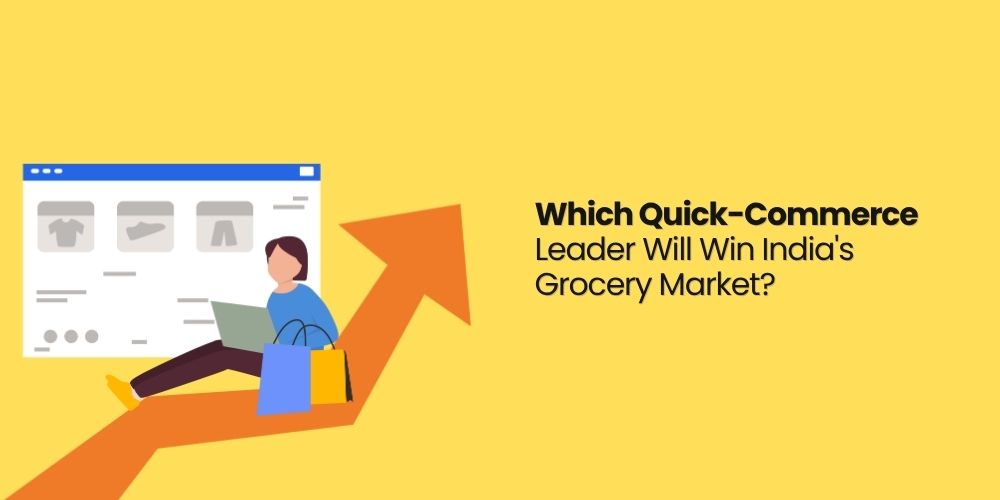
Which Quick-Commerce Leader Will Win India's Grocery Market?
 Introduction
The Indian retail environment is undergoing a major transformation phase like never before since the advent of online shopping in the country. Instead of waiting a day or two to receive deliveries, today's consumers demand groceries, medicine, electronic goods, beauty products, and even smartphones delivered within 10 to 20 minutes. This phenomenon has resulted in a fast growth of quick commerce companies, making ultra-fast deliveries a rapidly emerging digital business in the country.
Initially introduced as an innovative retail concept, grocery delivery services have now emerged as a multi-billion-dollar industry. Quick commerce companies today compete fiercely among themselves to build out their dark stores, become efficient in delivering orders, raise billions of rupees, and add new categories. The competition is no longer restricted to Blinkit, Zepto, and Swiggy Instamart. E-commerce powerhouses like Amazon, Flipkart, and BigBasket, which has backing from the Tata group, have also joined the battle for supremacy.
The challenge for investors is whether one of these quick commerce companies will be dominant in India's grocery business during the next ten years to come?
By understanding the capabilities, financial results, market position, scalability, and profitability of top quick commerce companies, investors can determine firms that stand to benefit . Explore India's booming quick commerce ccompanies and invest smarter with the best trading app in India to capture opportunities in the country's fastest-growing retail businesses.
What are Quick Commerce Companies?
Quick commerce companies has an online platform that operates by delivering products from micro-warehouses or dark stores within 10 to 30 minutes.
Unlike traditional e-commerce, which makes use of larger warehouses positioned outside metropolitan areas, quick commerce companies have adopted
small warehouses near the neighbourhoods of customers.
Process of making an order usually involves the following steps:
-
The customer places the order
-
The nearby dark store receives the order
-
The order is picked and packed
-
The delivery partner delivers the product to the customer in less than 30 minutes
Such an operating system has revolutionized consumer behavior, making instant delivery the most preferred way of shopping for many families.
Top 10 Quick Commerce Companies in India
Most of the top Indian quick commerce companies including Blinkit, Zepto, BigBasket, Flipkart Minutes, Amazon Now, JioMart Express, Dunzo, BB Daily, and FreshToHome are either privately owned or are subsidiary companies to larger conglomerates. This means that there is no way for people to invest directly in most of these brands using the Stock Exchange. But there are some public firms which indirectly allow people to invest in India's growing quick-commerce space due to ownership of platforms, logistics or consumer brands.
The following are the top 10 NSE-listed quick commerce companies where people can invest in India's quick-commerce space.
Comparative Analysis of Quick Commerce Companies
|
Company |
Market Cap Category |
Business Model |
Direct/Indirect Exposure |
Risk Level |
Investor Suitability |
|
Large Cap |
Platform Owner |
Direct |
Medium |
Growth Investors |
|
|
Large Cap |
Platform Owner |
Direct |
High |
Aggressive Investors |
|
|
Mega Cap |
Retail Ecosystem |
Direct |
Low |
Long-term Investors |
|
|
Large Cap |
FMCG + Retail |
Indirect |
Low |
Balanced Investors |
|
|
Large Cap |
Organized Retail |
Indirect |
Low |
Consumption Theme Investors |
|
|
Large Cap |
FMCG |
Indirect |
Low |
Conservative Investors |
|
|
Large Cap |
FMCG |
Indirect |
Low |
Dividend & Defensive Investors |
|
|
Large Cap |
FMCG |
Indirect |
Low |
Long-term Investors |
|
|
Large Cap |
FMCG |
Indirect |
Low |
Cautious Investors |
|
|
Large Cap |
FMCG |
Indirect |
Low |
Income & Growth Investors |
Why the Industry Is Growing So Quickly
Here are some structural factors that are driving the long-term success of quick commerce firms:
-
High rate of urbanization
-
Greater disposable income levels
-
Awareness of digital payments
-
AI-based demand forecasting
-
Better inventory management
-
Penetration of Tier-2 cities
-
Larger order baskets
-
Emergence of non-grocery categories like electronics, cosmetics, toys, and medical supplies
Unlike traditional online grocers, new-age quick commerce firms have the potential to become complete neighborhood stores capable of delivering thousands of products in minutes.
Start your investment journey with free demat account opening and discover companies driving India's quick-commerce revolution through innovation, technology, and rapid retail expansion.
Detailed Analysis of India's Leading Quick Commerce Companies
Below is the table, which identifies the important financial ratios for the top listed Indian quick commerce companies that are either directly or indirectly benefiting from the quick commerce ecosystem growth.
|
Company |
Market Cap (Approx.) |
ROE |
ROCE |
Net Profit Margin |
Debt Position |
|
Rs.2.4–2.6 lakh Cr |
Moderate |
Improving |
Improving |
Low Debt |
|
|
Rs.1.1–1.3 lakh Cr |
Negative/Improving |
Improving |
Loss-making but narrowing |
Low Debt |
|
|
Rs.21–22 lakh Cr |
9–10% |
9–11% |
8–9% |
Moderate |
|
|
Rs.1.1–1.3 lakh Cr |
14–16% |
16–18% |
9–10% |
Low Debt |
|
|
Rs.2.8–3.1 lakh Cr |
13–15% |
17–19% |
5–6% |
Virtually Debt-Free |
|
|
Rs.5.5–6 lakh Cr |
19–21% |
25–28% |
16–18% |
Debt-Free |
|
|
Rs.2.3–2.6 lakh Cr |
90%+ |
120%+ |
15–17% |
Debt-Free |
|
|
Rs.1.5–1.7 lakh Cr |
55–60% |
70%+ |
10–12% |
Debt-Free |
|
|
Rs.90,000 Cr+ |
18–20% |
22–24% |
18–20% |
Low Debt |
|
|
Rs.90,000–1,00,000 Cr |
30–35% |
40%+ |
13–15% |
Debt-Free |
This provides an insight into the important financial measures of India’s top listed quick commerce companies that are currently experiencing the direct or indirect benefits of the rapid growth of the quick commerce industry. Investors use such measures in order to compare the financial strength, profit generation ability, valuation, financial stability, and growth potential of these quick commerce companies. Such analysis will help the investors in finding the companies that will benefit from the increasing popularity of quick commerce in India.
Eternal Ltd. (Blinkit)
In Eternal, Blinkit's dominance in the marketplace has led the stock to become the leading listed stock which has been gaining from the trend of fast-growing companies. In the fiscal year 2026, the company has shown impressive growth in revenues, GOV, EBITDA margins, and operating leverage due to its growing scale in several cities. The company is gradually becoming a digital commerce ecosystem from a food delivery platform.
The future earnings growth will be driven by continued scaling of dark stores, order density, and improved unit economics of Blinkit.
There is a relatively low holding from promoters, whereas local mutual funds and FIIs continue to raise their shareholding, signaling confidence in the company’s growth strategy in the long term.
-
Fast growth in Blinkit’s dark stores.
-
High growth in electronics, lifestyle, and non-groceries categories.
-
Good performance in adjusted consolidated revenue and EBITDA for FY26.
- Investor-Focused Analysis
Eternal can be considered one of the best investment options for investors looking for direct investments in quick commerce companies of India. While Blinkit's leadership status and strong financials make it a good investment in the future, there are certain risks involved.
2. Peer Comparison
|
Parameter |
Eternal |
Swiggy |
|
Market Leadership in Quick Commerce |
Excellent |
Strong |
|
Profitability Trend |
Improving |
Improving |
|
Business Scale |
Largest |
Large |
Swiggy Ltd.
Swiggy reported strong revenue growth in FY26 while sharply cutting down on losses. Instamart experienced good growth in Gross Order Value (GOV). The improved contribution margins signified improved efficiency and cost management.
Given that Instamart is fast approaching contribution level profitability and food delivery division is earning steady profits, there exists an opportunity for Swiggy to create value for its shareholders in the long run.
While the promoters have reduced their stake since the listing of the company, the institutional holding of the firm has been on the rise.
-
The Instamart network was extended to over 1,100 dark stores.
-
The number of active users transacting per month kept growing.
-
Food delivery achieved EBITDA at its highest point yet.
- Investor-Centric Analysis
The company Swiggy provides diversified exposure for investors via food delivery, dining, and instant commerce. When compared to other pure-play quick commerce firms, it can be said that the diversified revenue stream can mitigate business risks.
2. Peer Comparison
|
Parameter |
Swiggy |
Eternal |
|
Food Delivery Leadership |
Excellent |
Very Strong |
|
Quick Commerce Presence |
Strong |
Excellent |
|
Business Diversification |
High |
High |
Reliance Industries Ltd.
Reliance Industries is advantaged by the fast development of the quick commerce players through JioMart, Reliance Retail, and its digital ecosystem. Sound cash flow, diversified operations, and strong balance sheets make the financial position flexible enough to enable investing in further retail business growth.
Further growth in organised retail, omnichannel business, and digital platforms will be helpful in achieving sustainable earnings and creating shareholder value in the long run.
The promoters hold majority ownership in the company, thus providing the necessary stability in terms of business strategy.
-
Increased instant delivery capabilities for JioMart.
-
Better synergy between physical retail and digital commerce operations.
- Investor-Centric Analysis
Reliance provides diversified exposure in retail, telecom, digital, and energy sectors as well as exposure to the growth of India’s quick commerce firms.
2. Peer Comparison
As compared to other retail-oriented firms, Reliance has financial flexibility due to diversified earnings and cash flows.
Tata Consumer Products Ltd.
Tata Consumer Products reported another year of robust double-digit revenue growth in FY26, backed by high demand in beverages, packaged food, and premium segments. Higher EBITDA and net profit indicate improved operating efficiency.
Strategic plans like Tata Sampann, Capital Foods, and increased engagement within the Tata Neu eco-system are likely to help the company increase its footprint in quick-commerce platforms.
The Tata Group retains a strong promoter holding, indicating good corporate governance and capital management practices.
-
FY26 revenue crosses Rs.20,000 crore mark.
-
Evolution of premium food and beverages products.
-
Addition to Starbucks network and premium portfolio.
- Investor Analysis
With quick commerce companies focusing more on premium packaged food, Tata Consumer Products is one of the few FMCG beneficiaries with excellent growth opportunities.
2. Peer Analysis
Among leading FMCG players, Tata Consumer Products maintains one of the most impressive revenue growth stories.
Avenue Supermarts Ltd. (DMart)
Avenue Supermarts still exhibits positive revenue growth due to its effective business model, tight control of costs, and near-zero leverage. Efficiency of operations is still considered to be one of the most prominent advantages of the company.
Growth in the DMart Ready business line and further development in the field of digital retail might reinforce the omnichannel strategy of the company; however, intensified competition of quick-commerce companies might affect the pace of future growth.
The company demonstrates very high promoter holding, which indicates a strong commitment and dedication of management.
-
Further expansion of the physical store network throughout India.
-
Continuing optimization of DMart Ready operations.
- Investor-Focused Analysis
While Avenue Supermarts does not run an independent quick-commerce website, it still remains a serious rival in the field of grocery retail. The company continues to act as a leader in the issues of pricing effectiveness and profitability.
Future Outlook (2027–2030)
The prospects of quick commerce companies seem very bright indeed . According to industry analysts, the industry will expand not only to the delivery of groceries but will eventually develop into a full-fledged neighbourhood commerce business model.
The following trends are expected to occur in the next five years:
-
Fast deliveries within 10 minutes
-
Utilisation of artificial intelligence for inventory management
-
Expansion into healthcare
-
The rise of electronics and fashion
-
Escalating levels of automation and robotics
-
Higher average order value
-
Operating leverage
In India, the quick commerce companies market size is projected to more than double by 2030, due to urbanisation and growth in income levels.
Overall Industry Scorecard
|
Parameter |
Winner |
|
Market Leadership |
Blinkit |
|
Technology |
Blinkit & Zepto |
|
Fastest Growth |
Zepto |
|
Customer Ecosystem |
Swiggy Instamart |
|
Brand Trust |
BigBasket |
|
Financial Strength |
Amazon |
|
Expansion Capability |
Flipkart & Amazon |
|
Product Diversification |
Blinkit |
|
Long-Term Investment Opportunity |
Eternal Ltd. |
|
Overall Industry Leader (2026) |
Blinkit |
Final Verdict
The Indian retail industry is undergoing changes with the emergence of quick commerce companies, which is a big opportunity for both consumers and investors. As blinkit, swiggy instamart, and others keep growing the market, there are also some companies listed in stock exchanges that have gained benefits from their partnerships in retail, logistics, and FMCG sectors. Before investing, investors need to look at the financial stability, growth potential, profitability, and positioning of the company as those companies that can grow their earnings would be future winners in India's quick-commerce sector. Identify the biggest beneficiaries of India's evolving quick commerce companies and invest confidently using the best brokerage accounts to build a future-ready portfolio.
Frequently Asked Questions
Who is the first quick commerce company in India?
Grofers which then changed its name to Blinkit is considered the first quick commerce company in India that implemented the ultra-fast delivery of groceries successfully.
Which are the top quick commerce companies in India?
The best quick commerce companies in India include Blinkit, Zepto, Swiggy Instamart, BigBasket BB Now, Flipkart Minutes, Amazon Now, JioMart Express, Dunzo, BB Daily, and FreshToHome (selected cities).
How big is the quick commerce market size in India?
The quick commerce market size in India is predicted to reach around US$11 billion by 2026, experiencing rapid growth annually.
Which are the new quick commerce companies in India?
Some of the new quick commerce companies in India are Flipkart Minutes, Amazon Now, and growing instant delivery services provided by JioMart. Some of the existing quick commerce companies include Blinkit, Zepto, and Swiggy Instamart.
Which are the top 5 quick commerce companies in India?
The top 5 quick commerce companies in India are Blinkit, Zepto, Swiggy Instamart, BigBasket BB Now, and Flipkart Minutes.
Disclaimer: This blog is dedicated exclusively for educational purposes. Please note that the securities and investments mentioned here are provided for informative purposes only and should not be construed as recommendations. Kindly ensure thorough research prior to making any investment decisions. Participation in the securities market carries inherent risks, and it's important to carefully review all associated documents before committing to investments. Please be aware that the attainment of investment objectives is not guaranteed. It's important to note that the past performance of securities and instruments does not reliably predict future performance.