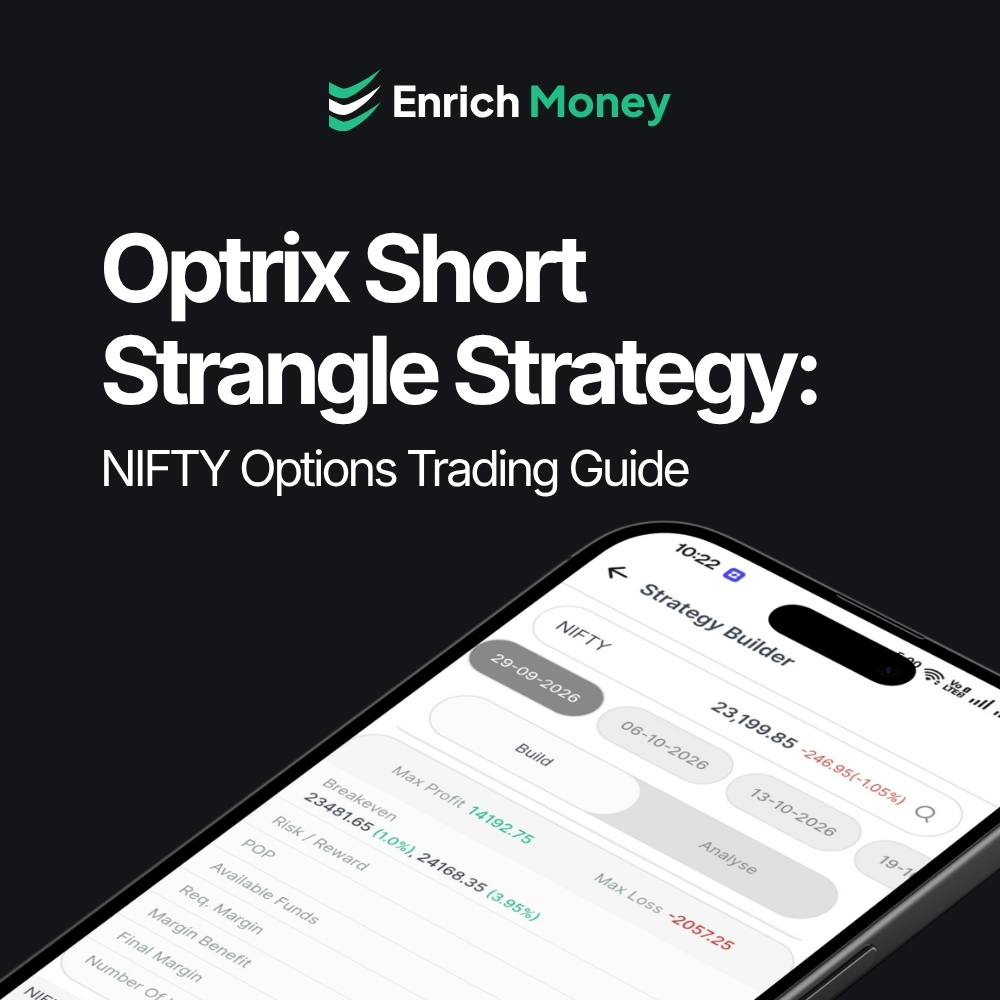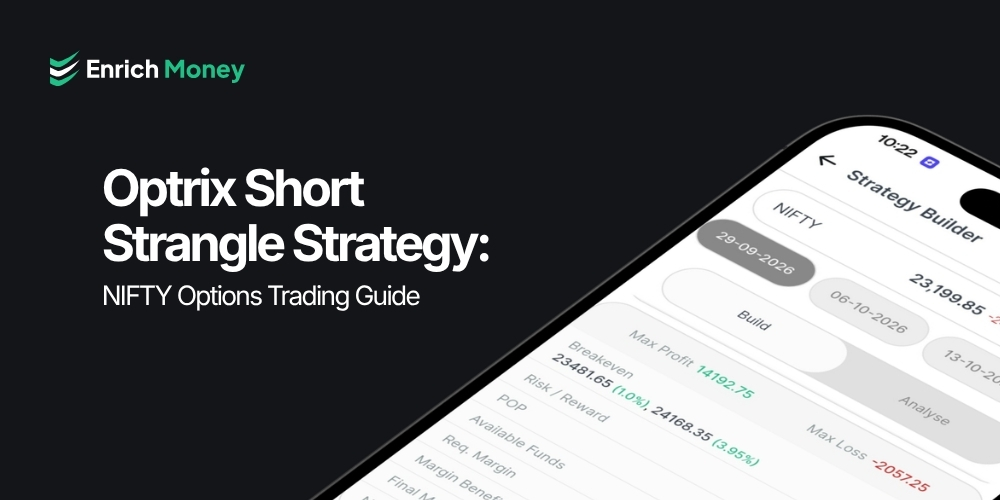
Optrix Options Trading Strategy: Neutral Short Strangle
Options traders often look for strategies that can benefit when the underlying asset remains within a defined price range. The Short Strangle is one such neutral options strategy. The Optrix strategy setup shown in the attached screenshots demonstrates how a trader can combine a short put and a short call with different strike prices to create a position that benefits primarily from time decay when the underlying remains relatively stable.

Explore options strategies like the Optrix Short Strangle conveniently through a feature-rich mobile trading app designed for on-the-go market access.
What Is a Short Strangle?
A Short Strangle involves selling an out-of-the-money put and an out-of-the-money call with the same expiry but different strike prices. The strategy is generally considered market-neutral because the trader expects the underlying to remain between the two strike prices rather than make a strong move in either direction.

In the Optrix example, the underlying shown is NIFTY, with the current price displayed at 22,622. The setup uses:
-
Sell 1 Put — 22,400 strike
-
Sell 1 Call — 22,800 strike
-
Expiry — 19 October 2026
-
Put premium — 63.00
-
Call premium — 63.05
-
Total premium received — 126.05 points
The two short options create a range in which the strategy can potentially retain its collected premium if NIFTY finishes within the relevant breakeven levels.
How the Optrix Setup Works
The Optrix screenshot shows a maximum profit of 8,193.25, while the displayed maximum loss is Unlimited. This is an important characteristic of an unhedged short strangle.

The maximum profit is achieved when the underlying expires between the two short strikes, because both options can expire without intrinsic value. In the supplied setup, the payoff display shows the maximum expiry profit of 8,193.25.

The displayed breakeven levels are approximately:
-
Lower breakeven: 22,273.95
-
Upper breakeven: 22,926.05
These levels are calculated around the short strikes after accounting for the total premium received. Therefore, the strategy has a profit zone between the two breakeven points at expiry, subject to the assumptions and lot-size calculations shown by the platform.
Profit Potential
The primary attraction of a Short Strangle is the premium collected at entry. In the Optrix example, the put and call premiums total 126.05 points.
If NIFTY stays comfortably between the short strikes until expiry, both options may expire with little or no intrinsic value, allowing the trader to retain much or all of the collected premium.

The payoff chart in the supplied screenshot illustrates this clearly. The green expiry payoff remains at the maximum-profit level across the central region around the 22,400–22,800 strikes, before turning downward when NIFTY moves beyond the profitable range.
Risk and Maximum Loss
The major risk of an uncovered Short Strangle is that losses can become very large if the underlying makes a substantial move.
A sharp decline can create losses on the short put, while a strong rally can create losses on the short call. Unlike the maximum profit, which is limited to the premium collected, the displayed maximum loss for the strategy is Unlimited.
This makes risk management particularly important. Traders should monitor the underlying, option prices, implied volatility and remaining time to expiry rather than treating the collected premium as risk-free income.
Probability of Profit and Margin
The Optrix strategy panel displays a Probability of Profit (POP) of 32.34% for the configuration shown.
The screenshot also indicates:
-
Required margin: Rs.1,81,557.02
-
Final margin: Rs.1,81,557.02
-
Number of legs: 2
These figures are specific to the setup captured in the document and can change with market prices, volatility, expiry, strikes, lot size and broker margin requirements.
Wondering can I open demat account for minor? Explore the applicable rules and account options before starting your investment journey.
Understanding the Greeks
The Greeks section provides another way to understand the position's behaviour.

For the combined strategy, the screenshot shows:
-
Delta: -0.05
-
Theta: 25.82
-
Rho: -3.09
-
Gamma: -0.0019
-
Vega: -17.83
The near-zero delta indicates that the combined position is relatively neutral to a small directional movement at the displayed price. Positive theta indicates that, all else being equal, the passage of time can benefit the short-option position.
The negative vega is also significant. A rise in implied volatility can work against a short strangle, while a decline in implied volatility can generally support the position. Gamma is negative, highlighting the increasing sensitivity of a short-options position as the underlying makes larger moves.
Why Traders May Consider a Short Strangle
A Short Strangle may appeal to experienced options traders who have a neutral outlook and expect the underlying to remain range-bound. It can also benefit from time decay and, depending on market conditions, a decline in implied volatility.
However, the strategy is not simply a way to collect premium. Its unlimited-loss characteristic means that a trader must have a clearly defined risk-management approach.
Possible considerations include monitoring the position regularly, establishing exit rules, adjusting strikes when appropriate, or using protective options to create a defined-risk alternative.
Key Takeaway
The Optrix Neutral Short Strangle example on NIFTY combines a short 22,400 put and a short 22,800 call expiring on 19 October 2026. The setup receives a combined premium of 126.05 points and shows a maximum profit of 8,193.25, with displayed breakeven levels of approximately 22,273.95 and 22,926.05.
The strategy is most suitable for a market view in which the trader expects limited movement around the current price. At the same time, the unlimited-loss profile makes risk management essential.
Options involve substantial risk, and traders should understand the payoff and margin requirements before entering an uncovered position.
Compare the best stock brokerage firms to find platforms offering suitable tools, pricing, and support for options traders.
Frequently Asked Questions
What is the Optrix Short Strangle strategy?
The Optrix Short Strangle is a neutral options strategy designed to benefit when the underlying asset stays within a selected price range.
How does a Short Strangle work?
It involves selling an out-of-the-money call and put with the same expiry to collect option premiums.
When is the Optrix Short Strangle suitable?
This strategy may suit traders expecting limited price movement and relatively stable market conditions.
What is the main risk of a Short Strangle?
Large moves beyond the strike prices can create substantial losses because the sold options carry significant directional risk.
Can the Optrix Short Strangle generate regular income?
It can potentially earn premium income when the market remains within the expected range, but returns are not guaranteed.
Disclaimer: This blog is dedicated exclusively for educational purposes. Please note that the securities and investments mentioned here are provided for informative purposes only and should not be construed as recommendations. Kindly ensure thorough research prior to making any investment decisions. Participation in the securities market carries inherent risks, and it's important to carefully review all associated documents before committing to investments. Please be aware that the attainment of investment objectives is not guaranteed. It's important to note that the past performance of securities and instruments does not reliably predict future performance.