How to Select the Index, Stock, and Expiry in the Options Chain in ORCA Enrich Money
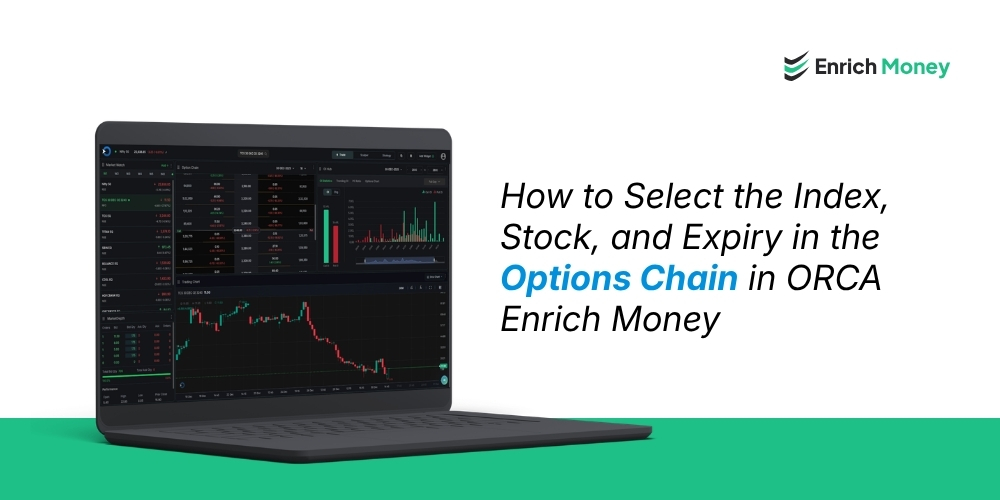
The options trading process begins with the proper selection of the underlying instrument and the expiry contract. Irrespective of whether you are analyzing Nifty, Bank Nifty, Sensex, or even any F&O stocks, picking the right combination will ensure that the options prices being displayed on your screen are the correct ones. ORCA offered by Enrich Money provides an easy-to-use interface where one can easily swap between indices and stocks of different expiry contracts and view option analysis . Master options trading with ORCA by opening a free demat account and trading account to seamlessly analyse indices, stocks, expiries, and Option Chain data on a single platform.
Why Selecting the Right Index, Stock, and Expiry is Important
The Option Chain will provide information that is related to the particular underlying security and expiry date that you have chosen. In case of selecting the incorrect stock or expiry date, then the information regarding option premiums, OI, and the Greeks that will be appearing on the screen will not be relating to the particular contract that you want to analyze. Thus, selection of the index or stock and expiry date is the first step of your options analysis.
Step 1: Open Your Watchlist
|
|
Start by logging in to the Enrich Money application. Once logged in, you will arrive at the Watchlist section, where all the stocks and indices that you love are listed out. On this page, you have the option to pick any of the available indices, including Nifty 50, Nifty Bank, or Bankex, as well as any F&O stock including Maruti, Reliance, Tata Motors, TCS, or HDFC Bank. A simple tap on the stock/indices takes you to its market page. |

Step 2: Navigate to the Option Analysis Section
|
|
After the page of stock/index is opened, there will be several tabs for analyzing the same which include Technicals, Option Analysis, and Futures. In order to find out the option-based information, you need to click on the Option Analysis tab. This tab serves as a dashboard which contains various analytics tools like Option Chain, OI Analysis, OI Surge, OI Statistics, Trending OI, and PCR. As we want to analyze the options contract, select the Option Chain tab. |

Step 3: Select the Required Expiry
On the top of the Option Chain screen, ORCA lists all the expiry dates of the chosen stock or index. There might be different expiry dates including weekly as well as monthly ones according to the underlying asset. Some expiry dates include 25-Aug-2026, 29-Sep-2026, and 27-Oct-2026 among others. Just tap the required expiry date corresponding to your trading strategy and the system instantly updates the Option Chain and shows the respective data . Weekly expiry dates are more convenient for intraday and short-term traders in terms of higher price movements during short periods of time. Monthly expiry dates will be preferable for those traders who wish to keep their positions open for a more extended period of time.
Step 4: Study the Option Chain
Once expiry is selected in the Option Chain, all available strike prices for Call (CE) and Put (PE) options are shown. Strikes are placed according to the present spot price; this will make it easier for the trader to know about the ATM, ITM, and OTM options . Besides the premiums of options, ORCA also gives some details like open interest, analysis of option trading activities, and other market figures. With this arrangement, the traders can see where the market participants are placing their positions before making a trade on any strike price.
Step 5: Enable Greeks for Advanced Analysis
|
|
Traders that need more information about option pricing can use the Greeks toggle on the Option Chain screen in ORCA. Upon activation of the Greeks toggle, some additional parameters like Delta, Gamma, Vega, Theta, and IV are displayed for each strike price. The option Greeks are essential tools that allow traders to assess how the options prices can behave in response to changes in the price of the underlying asset, time until expiry, and volatility of the market. Delta is an indicator of an option's sensitivity to the price of the underlying asset, Theta shows the effects of time decay, Vega indicates changes caused by implied volatility, and Gamma shows how Delta changes. |

Step 7: Compare Different Expiry Contracts
ORCA Option Chain also provides an edge over other tools by enabling users to instantly switch between various expiry periods. This enables them to compare prices, implied volatility, Open Interest and market sentiment between weekly and monthly options to find out which one would be better for them depending on their trading period.
Choosing Between Weekly and Monthly Expiry
Selection of either weekly or monthly expiries will depend on the trading goals you have in mind. Weekly options are normally favoured by intraday or expiry-day oriented traders or those who buy options in the short term. Monthly options, on the other hand, are chosen by traders who tend to hold their positions for several days or weeks due to better liquidity and suitability for positioning and selling options . Choose the right weekly or monthly expiry and sharpen your options strategies with the best demo trading app India before entering live markets.
Common Mistakes Traders Should Avoid
Beginners tend to mis-analyze and trade the wrong expiry because they do not bother checking the contract selected for trade. Some others make the mistake of not considering certain things such as Open Interest, liquidity or spot price when choosing the strike prices. There are some traders who forget about the importance of option Greeks although they are essential in understanding the concepts of time decay and volatility.
Why Use the ORCA Option Chain?
ORCA Option Chain is developed in such a way that traders can conduct a complete analysis of options through one application without having to move from one application to another. In addition to real-time data on options, there are some additional features included in this application, such as OI Analysis, OI Surge, OI Statistics, Trending OI, PCR, and Option Greeks.
Conclusion
Choosing the right index, stock and expiry is the basis of good options analysis. ORCA Enrich Money helps users to do this in a simple way through its user-friendly interface and analysis tools such as Option Chain, Open Interest figures and Greeks. It becomes easier for users to conduct trend analysis after selecting the right contract by utilizing these tools . Master options trading with ORCA Enrich Money and maximise your rewards through the trading account refer and earn program while accessing powerful market analysis tools.
Frequently Asked Questions
How do I choose an index or stock in the ORCA Option Chain?
Choose the desired index or F&O stock through the Watchlist and enter into the Option Analysis module.
Why do I need to choose the right expiry before analysing the options?
This allows me to see the right option premiums, Open Interest, and Greeks for the particular contract.
Can I go to both weekly and monthly expiry contracts in ORCA?
Yes, I can just tap on the desired expiry date and get data for the respective Option Chain.
What more will I be able to know about an option with the option to see the Greeks?
Enabling Greeks gives information about Delta, Gamma, Vega, Theta, and Implied Volatility that will help assess the price behavior of the option.
Why is the ORCA Option Chain beneficial for option traders?
Because it provides live Option Chain data, OI analysis, Greeks, and other market parameters at one platform.
Disclaimer: This blog is dedicated exclusively for educational purposes. Please note that the securities and investments mentioned here are provided for informative purposes only and should not be construed as recommendations. Kindly ensure thorough research prior to making any investment decisions. Participation in the securities market carries inherent risks, and it's important to carefully review all associated documents before committing to investments. Please be aware that the attainment of investment objectives is not guaranteed. It's important to note that the past performance of securities and instruments does not reliably predict future performance.