How to Use Greeks in the ORCA Option Chain
Introduction
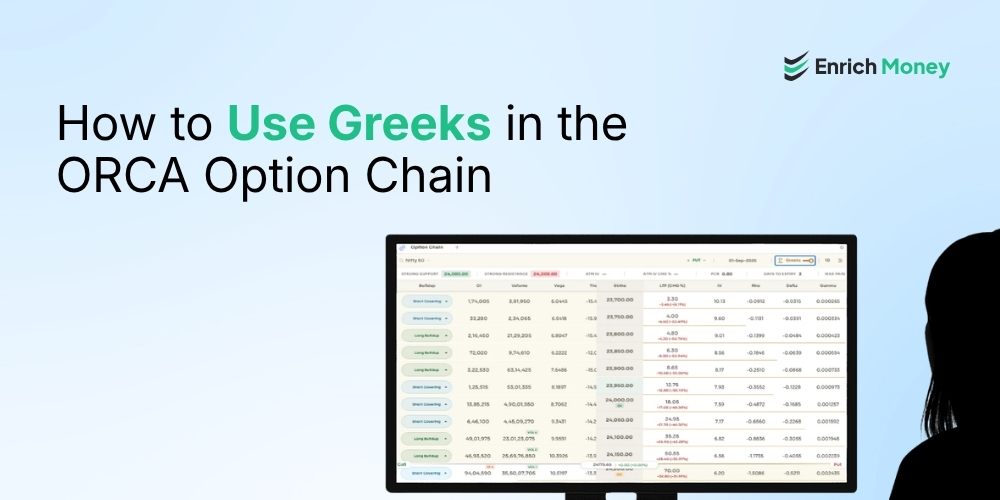
Options traders often evaluate more than an option's premium and Open Interest (OI) before placing a trade. Changes in the underlying asset, time to expiry and volatility can influence an option's value. Option Greeks help traders understand these sensitivities and compare different option contracts.The ORCA Option Chain on the web platform provides a Greeks view, allowing traders to view Delta, Gamma, IV, Theta, Rho and Vega alongside other option-chain data. This brings multiple analytical inputs together on the same interface . For traders comparing a best trading app start from 10 rupees, access to integrated options-analysis features can be one factor to consider when evaluating a trading platform.
How to View Greeks in the ORCA Option Chain?
To access the Greeks view on the ORCA web platform:
Step 1: Open the ORCA web platform and navigate to the Option Chain.
Step 2: Select the required stock or index and choose the relevant expiry.
Step 3: Locate the Greeks option available on the Option Chain.

Step 4: Select the Greeks view to display the additional metrics alongside the strike prices.
Once enabled, the Option Chain displays Delta, Gamma, IV, Theta, Rho and Vega for the available Call and Put contracts.
What Greeks Can Traders View on ORCA?
|
Metric |
What It Indicates |
|
Delta |
Shows how an option's value may respond to movements in the underlying asset. |
|
Gamma |
Rate at which Delta changes when the underlying asset moves. |
|
Theta |
Theoretical effect of time decay on an option's value. |
|
Vega |
Shows how an option's value may respond to changes in implied volatility. |
|
Rho |
Sensitivity to changes in interest rates. |
|
IV |
Volatility implied by the option's market price. |
Each metric provides a different perspective on an option contract.
How Can Traders Use Greeks?
Delta can help traders understand how responsive an option may be to movements in the underlying asset, while Gamma provides information about how Delta can change as the underlying moves . Theta helps traders assess the potential effect of time decay. This can be particularly relevant as an option approaches expiry . Meanwhile, IV and Vega can help traders evaluate the volatility component of an option. Rho provides information about the option's sensitivity to interest-rate changes . These metrics should be interpreted together and should not be treated as individual buy or sell signals.
Example: Comparing Options in ORCA
Consider the Reliance Industries Option Chain in ORCA. With the underlying trading around ?1,311, traders can compare different Call and Put contracts around the current price.
The standard Option Chain displays information such as LTP, LTP changes, OI and OI Interpretation. By enabling the Greeks view, traders can additionally compare Delta, Gamma, IV, Theta, Rho and Vega for the selected contracts.This provides additional context when comparing options without requiring a separate tool for each metric.
Analyse Greeks Alongside OI
The Greeks view can be considered alongside other information available in the ORCA Option Chain, including strike price, LTP, LTP changes, OI and OI Interpretation . For example, traders can examine the OI position at a strike while also considering the option's sensitivity to the underlying price, time decay and volatility. Combining these data points can provide a broader view of an option contract . However, no single indicator can predict an option's future price or guarantee a trading outcome . When evaluating a trading setup, traders should also consider applicable demat account costs and other charges as part of their overall trading requirements.
Why Use Greeks in ORCA?
The Greeks view brings important options-analysis metrics directly into the Option Chain. Traders can:
-
Compare different strike prices using multiple metrics.
-
Understand an option's sensitivity to underlying price movements.
-
Evaluate the potential impact of time decay.
-
Assess volatility-related factors using IV and Vega.
-
View Greeks alongside LTP and OI information.
-
Analyse multiple parameters without switching between separate tools.
This makes the Greeks view a useful addition for traders who want to examine option contracts using more than just premium and OI data.
Conclusion
The Greeks feature in the ORCA Option Chain provides traders with access to Delta, Gamma, IV, Theta, Rho and Vega within the web-platform interface. By viewing these metrics alongside strike prices, LTP and OI information, traders can consider different factors that may influence an option's value . Greeks are best used as part of a broader analysis rather than as standalone trading signals. Traders should consider them alongside market conditions, price movement, OI, volatility and their individual trading strategy . For traders exploring a demat account opening app, integrated market-analysis features such as an Option Chain with a Greeks view can be a useful part of the overall trading platform experience.
Frequently Asked Questions
What are Option Greeks in ORCA?
Option Greeks are metrics that help traders understand an option's sensitivity to factors such as changes in the underlying asset, time, volatility and interest rates. ORCA provides Delta, Gamma, Theta, Vega, Rho and IV in its Option Chain.
How can I view Greeks in the ORCA Option Chain?
Open the ORCA web platform, navigate to the Option Chain, select the required stock or index and expiry, and enable the Greeks view. The relevant Greek values will then appear alongside the option-chain data.
Which Greeks are available on ORCA?
The ORCA Greeks view displays Delta, Gamma, Theta, Vega and Rho, along with Implied Volatility (IV) for Call and Put options.
What does Delta indicate in the ORCA Option Chain?
Delta indicates how sensitive an option's value may be to changes in the price of the underlying asset. It can help traders understand the option's price sensitivity.
What is Theta in the ORCA Option Chain?
Theta indicates the theoretical effect of the passage of time on an option's value. Time decay can become an important consideration as an option approaches expiry.
Disclaimer: This blog is dedicated exclusively for educational purposes. Please note that the securities and investments mentioned here are provided for informative purposes only and should not be construed as recommendations. Kindly ensure thorough research prior to making any investment decisions. Participation in the securities market carries inherent risks, and it's important to carefully review all associated documents before committing to investments. Please be aware that the attainment of investment objectives is not guaranteed. It's important to note that the past performance of securities and instruments does not reliably predict future performance.