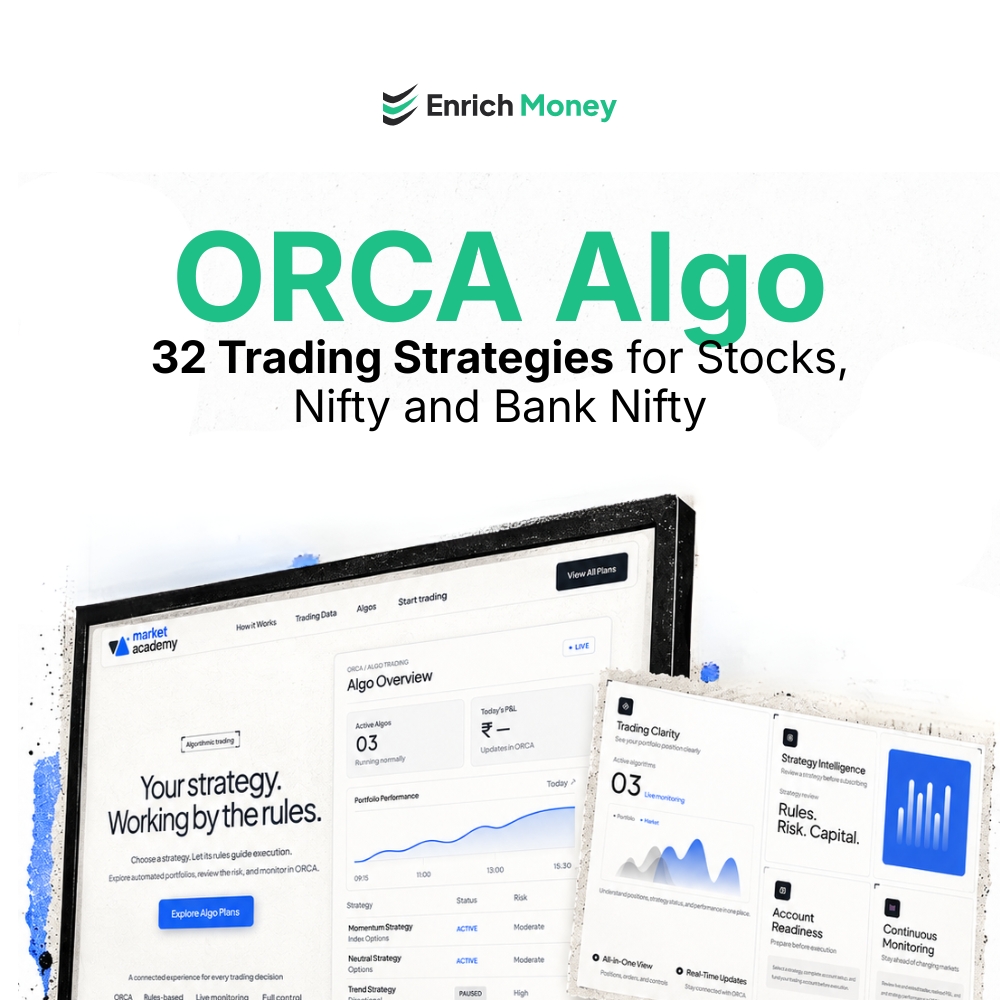
ORCA Algo: 32 Trading Strategies for Stocks, Nifty and Bank Nifty
Introduction
While selecting a trading strategy, traders have to take into consideration more than just market trends. Factors like amount of capital, risks involved, types of assets, past performance, and maximum drawdowns all form an integral part of choosing a strategy.
Enrich Money ORCA Algo provides 32 different trading strategies for stocks, Nifty, Bank Nifty, and portfolio-related strategies. Traders can select different strategies depending upon their own trading goals, available capital and risk appetite.
Depending upon your trading objectives, whether they are for intraday trading, futures and options, or portfolio oriented strategies, having knowledge about the various algorithms available could assist you to decide in making a better choice.
Explore the best demo trading app India to compare available algorithmic strategies for stocks, Nifty and Bank Nifty.
1. Multiple Strategy Categories in ORCA Algo
One trading strategy may not work well for all market conditions and types of investors. An intraday trader focused on quick market gains may have different requirements from a long-term investor seeking to build a diversified stock portfolio.
The ORCA Algo takes into consideration the various needs of the traders/investors through multiple strategies on different instruments and styles.
Stock-Based Trading Strategies
Stock-based strategy concentrates on the possibilities associated with individual listed companies and their derivatives. The type of the strategy determines what stock futures, stock options, and even portfolios traders can consider.
For instance, the ORCA Algo strategies are Stock Futures – Liquidity Edge, Stock Options Snapper, Stock Orbit, and Stock Opportunity Portfolio. Different strategies vary depending on their choice of instruments, period of trading, risk classification, and also the required capital.
Intraday stock strategies will work for traders who aim at making profits through day-trading, while portfolio-oriented strategies will suit individuals looking for exposure in specific stocks.
For seasoned traders, the critical aspect is not only the annualized return on investment (CAGR). Factors like liquidity, quality of execution, drawdown, concentration, and margin are also important when choosing a strategy.
Index-Based Strategies: Nifty and Bank Nifty
Strategies based on indices consider indices as the benchmark instead of stocks of companies. ORCA Algo consists of various strategies that are related to Nifty as well as Bank Nifty, including selected futures and options strategies.
The list of Nifty strategies consists of Nifty Alpha Ladder, Nifty Alpha Edge, Nifty Magnet, Nifty Thunderbolt, and Nifty IronClad. The provided strategy information also includes Titan Naked Blitz – BankNifty, which is associated with Bank Nifty futures.
How Can Traders Use ORCA Algo to Explore Trading Strategies?
ORCA Algo is an integrated tool which allows users to analyze various trading strategies offered by the platform. Prior to choosing a certain strategy, a trader should study all the details concerning it.
The important aspects that you may consider include the following:
-
Strategy categories: Analyze the offered stock, index and portfolio strategies.
-
Risk class: Compare risk classes of different strategies.
-
Capital: Check the listed amount of capital required to find potentially profitable strategies in accordance with your financial resources.
-
Performance: Look at the offered performance indicators such as CAGR and Max Drawdown.
-
Trading instruments: Consider whether the strategy uses stocks, futures, options and/or indexes.
Such comparisons will help you to analyze the strategies more deeply than just based on their profitability. However, the actual suitability of the strategy will depend on many factors.
ORCA Algo Strategy Comparison Table
|
Strategy category |
Example strategy |
Risk level shown |
Displayed capital requirement |
Instrument / approach |
|
Nifty options |
Nifty Alpha Edge |
Medium |
Rs.80,000 |
Hedged options |
|
Nifty momentum |
Nifty Thunderbolt |
High |
Rs.60,000 |
Hedged options, intraday |
|
Nifty risk-focused |
Nifty IronClad |
Low |
Rs.10 lakh |
Hedged options, intraday |
|
Bank Nifty trading |
Titan Naked Blitz – BankNifty |
High |
Rs.2.5 lakh |
Bank Nifty futures, intraday |
|
Stock futures |
Stock Futures – Liquidity Edge |
High |
Rs.4 lakh |
Stock futures, intraday |
|
Stock options |
Stock Options Snapper |
High |
Rs.40,000 |
Stock options |
|
Stock portfolio |
Stock Opportunity Portfolio – I |
Low |
Rs.5 lakh |
Large-cap and mid-cap stocks |
|
Portfolio accumulation |
Institutional Accumulation Portfolio |
Low |
Rs.2 lakh |
Large-cap and mid-cap stocks |
|
Index futures |
Nifty Orbit |
High |
Rs.2.5 lakh |
Nifty futures |
Note : Confirm current specifications on ORCA before trading.
Compare strategy capital requirements with applicable demat account fees before estimating your overall trading budget.

Trading-Focused and Investing-Focused Strategies
The other major distinction is between trading strategies and portfolio-oriented strategies.
Trading- oriented strategies are usually aimed at short-term opportunities in the market. Some examples of such strategies include intra-day momentum strategies, selected futures strategies, and option strategies.
Portfolio-oriented or investing-oriented strategies can be directed at constructing or managing stock exposure in the medium to long term. Examples include strategies such as Stock Opportunity Portfolio - I, Stock Opportunity Portfolio - II, and Institutional Accumulation Portfolio provided by ORCA Algo.
They have different purposes and objectives. While active traders will value trade frequency, capital efficiency, and fast execution, investors may prefer diversification, management of draw-downs, and consistency.
However, it doesn't mean that portfolio-oriented means low-risk or long-term investment strategy. Each user should check a holding period, instruments used, short selling exposure, and exit strategy of each strategy.
Strategies for Different Capital and Margin Requirements
Availability of capital can also be considered when selecting the algorithmic trading strategy. ORCA Algo categorizes the market capital allocation into four main categories:
-
Up to Rs.1 lakh
-
Rs.1 lakh-Rs.2.5 lakh
-
Rs.2.5 lakh-Rs.5 lakh
-
Beyond Rs.5 lakh
The provided strategy details also show individual capital requirements, which range from Rs.35,000 for Stock Intraday - Liquidity Edge strategy to Rs.16.5 lakh for Nifty Magnet strategy.
This helps users compare various strategies based on their available trading capital rather than considering performance figures alone. The strategy capital requirement mentioned is not the minimum investment required or the total cost of trading.
In case of futures and option strategies, traders need to consider extra margins that may depend on the structure of the position, broker requirements, volatility, and other exchange regulations. Users must also consider brokerage charges, taxes, slippages, and a buffer to accommodate market unfavourable movement.
Comparison of Strategies According to Available Capital
Imagine that a trader has Rs.1 lakh at hand for trading. The trader shouldn’t choose a strategy merely due to its capital requirement being within this range but also consider additional margins, fees and money that is needed for protection against market moves in the wrong direction.
So, for instance, the Stock Options Snapper mentioned in this article with the displayed capital requirement of Rs.40,000 may become one of the candidates for comparison at first glance. But then the trader should double-check the actual requirements, structure of the options position, possible losses and drawdowns.
The idea is to select those strategies which correspond to the trader’s financial resources and risk preference, not just pick the one which requires less capital.
Considerations before Choosing an ORCA Algo Trading Strategy
-
Funds requirement: Check how the capital shown compares to your capital and additional margin requirements.
-
Risk/Maximum Drawdown: Look at the risk rating and maximum drawdown of the strategy.
-
Trade characteristics: Align the instruments and the type of trades conducted in the strategy to your goals.
-
Total cost of trades: Factor in all costs including commissions, taxes, slippage, etc.
Note that no risk rating can guarantee you from loss and the past performance does not guarantee future results.
Conclusion
ORCA Algo provides traders with 32 strategies for stock, Nifty, Bank Nifty and portfolios trading, enabling them to have various choices according to their aims and the size of their capital.
Nevertheless, when it comes to choosing an algorithmic strategy, one needs to consider much more than only comparing historical CAGR and taking the strategy that has the lowest capital requirement shown.
Explore Enrich Money's best trading account and learn about the available strategies and their features. Please compare the strategies with your trading goals, financial capabilities and risk profile before deciding to commit any capital.
The past performance of any investment is not indicative of its future performance. Algorithmic trading carries risks of loss.
Frequently Asked Questions
What is ORCA Algo?
ORCA Algo is the trading platform by Enrich Money to explore 32 algorithmic trading strategies through stocks, Nifty, Bank Nifty, and portfolios.
What kind of trading strategies are available at ORCA Algo?
ORCA Algo has trading strategies based on stocks, indexes, futures, options, intraday trading and portfolio.
What amount of capital is needed to use ORCA Algo?
The amount of capital displayed differs according to the strategies varying between ?35,000 and ?16.5 lakh as per the strategies explained in this article.
How do traders choose ORCA Algo strategy?
Traders must consider capital requirements, risk classification, CAGR, maximum drawdown, instrument types, and transaction costs before choosing a strategy.
Is there a profit guarantee using ORCA Algo?
No, algorithmic trading involves market risks and past performance does not imply future returns.
Disclaimer: This blog is dedicated exclusively for educational purposes. Please note that the securities and investments mentioned here are provided for informative purposes only and should not be construed as recommendations. Kindly ensure thorough research prior to making any investment decisions. Participation in the securities market carries inherent risks, and it's important to carefully review all associated documents before committing to investments. Please be aware that the attainment of investment objectives is not guaranteed. It's important to note that the past performance of securities and instruments does not reliably predict future performance.