Automated Trading Systems: Architecture, Protocols, Types of Latency
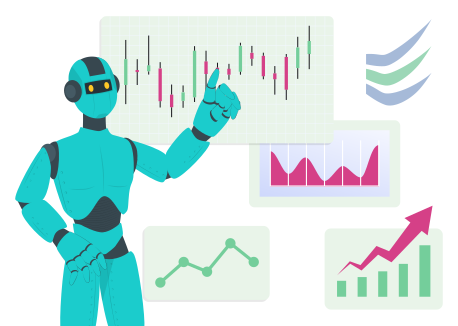
Almost every security traded in today’s global and domestic markets is in electronic mode. Further, more than half of them are carried out through an automated process. Another half of the counterparty (i.e., buyer or seller) is triggered by a predefined logic placed within a machine. This machine robot represents an automated trading system.
What are Automated Trading Systems?
-
Share markets are dynamic data domains. Traders make trading strategies based on price movements, flowing news, and complete analysis. An Automated Trading System takes the place of the trader, studies the live market data inflow, looks for signals, decides the type of trade, and inputs a set of instructions (an Algorithm) into the Trading interface of an Exchange (e.g., NEAT of NSE), which is a buy/sell order.
-
How does a machine know trading strategies? Simply because various combinations of algorithms have been predefined in the software to respond to typical market price movements and their theoretical analytics executing trade decisions.
-
An Automated Trading System consists of the hardware and software that automatically performs all of the above functions. Most Auto systems function via an API (Application Programming Interface) between the Trading Platform and Client dashboard.
Difference Between Traditional Trading Systems Vs Automated Trading Systems?
How were the early Trading systems and methods fledglings compared to today’s automated trading software? The differences were:
1. The emergence of High-Frequency Trading (HFT)
As against traditionally built models, in the case of Algo trading software, the turnover contribution of Institutional fund managers and Investors, along with large banking companies and Brokers could increase exponentially due to the quickness of communication. It opened up the era of High-Frequency Trading (HFT). The profit-making profile of trading changed from Maximizing profits to Risk: Reward ratios. This kind of trading spreads to every security type, Equity, Debentures, Bonds, T-Bills, Notes, Commodities, Currencies, Interest rates, and Derivatives of instruments. This implies very high daily portfolio turnovers and a very high Order-to-Trade ratio in the automated trading world, demanding multi-dimensional trading systems.
2. Latency limitations
Large and voluminous trade orders require instantaneous and direct access to the dynamic market with the fastest connections. Traditional trading systems were supported by low bandwidth (smaller information packets), high latency (delays in data movements), and the absence of suitable network protocols for Order flow and Market data access.
Limitations of Traditional Trading Systems
Traditional trading systems suffered from many handicaps, which delayed the transition towards Algo trading systems and methods. They were:
-
Time gaps in data arrival, ie. Latency sensitivity.
-
Inability to react to short-lived trading opportunities due to the above reason
-
Network bottlenecks that affected the precision of data received by clients
-
Throughput/Bandwidth divergence, which is the gap between maximum transmittable data in unit time as against the transmitted data volumes (Mbps)
Technological innovation needs huge investments, which also serves as a limiting factor.
Beyond the technological realm, another limitation in traditional trading has always been the high margins required for high-volume trading. In some global cases, Dark Pool trading (privately organized trades), enabled by existing trading systems, allowed institutions to stay with negotiated OTC trades.
Algo Trading Software and Methods
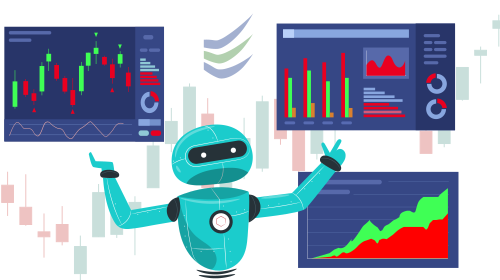
Initially, Algo trading software (also called Black Box trading), based on an automated order execution concept, originated around the 1950s. It picked up momentum around 1980, but the technical computational and networking support only received its impetus after 2005. Once established, by 2015, a predominant percentage of turnovers in the US exchanges were auto trade-driven.
In a nutshell, Algo Trading differentiated itself in 2 ways from its predecessors.
-
Trading models consisting of a series of strategies were pre-fabricated and listed as trade options within an application. The models depended upon the type of security traded, trading time frame, and the Client’s acceptable risk levels.
-
The choice was left to a computer model, a machine decision (not man-made), based on the best fit for the ongoing market conditions.
Advancements in volume and speed in communication have contributed hugely to the practical implementation of Algo trading applications. Nowadays, speeds of thousands of orders per microsecond have been made possible. At the same time, the market regulations regarding Auto trading are also evolving. SEBI regulates them through a slew of measures such as Algo trading platform approval and Algorithm approval by Exchange, Broker control over the software on their servers, client order confirmation, and margin maintenance. Built-in checks such as two-factor authorization for login to auto trading software must also be ensured to prevent hacking and retain control/ownership over overtrades.
Advantages of Automated Trading Software
-
Automated trading software has arrived because of the Client’s need to take control of the trading process and execute orders from the comfort of his desk. This makes him feel less dependent on Brokers and associated paperwork.
-
Another advantage has been the cost reduction due to lesser transaction/execution costs. This has a direct impact on the trader’s Profit and Loss.
-
Algo trading software has the added merit of ensuring better risk management. Traditional price watches and manual placement of orders led to the sway of emotions. Due to this subjectivity, the trader was often prone to untimely entry and exit of positions, not enforcing limit losses, trading low probability trends, intraday overtrading, missing profit opportunities due to lack of control, etc. However, Algo trading, based on time-tested technical tools such as Momentum, Moving Averages, Stochastics, and Volume Weighted Average Price, is built to correlate signals from multiple indicators. This ensures a better success percentage.
-
Algo software gives Trading members (Brokers) the option to locate Algo servers hosting the trading and market data capture functions directly within the premises of Exchanges.
-
Exchanges such as NSE and BSE permit Co-location or Proximity hosting by renting space out to place Automated platforms close to the Exchange’s computer mainframes. This helps hasten the Order communication and execution process by a number of milliseconds, giving a speed lead that can be passed on to Clients. This has also provided a good stream of revenue to the exchanges.
Conclusion:
Financial information exchange has joined hands with Artificial Intelligence (AI) to eliminate all forms of manual intervention by a human hand that used to be a trader’s.
Currently, a variety of Algos exist (First generation ones, e.g., Delta Neutral, Mean Reversion, VWAP, TWAP, Average OHLC, POV, Black Lance, The Peg) or more of a hybrid variety (Serial Algos, Iterative Algos, etc.).
With a long list of positive attributes such as accuracy, speed, price improvement, trader productivity, lower cost, better risk management, and anonymity of counterparty, Automated trading systems will only increase liquidity and participation of institutional and retail investors, creating a more vibrant market in India.
The success of its use will, however, depend upon,
-
guarding against security breaches using adequate firewalls
-
preventive action against market manipulation and
-
Investor education to understand the product and optimize its realistic functions.
Disclaimer: This blog is dedicated exclusively for educational purposes. Please note that the securities and investments mentioned here are provided for informative purposes only and should not be construed as recommendations. Kindly ensure thorough research prior to making any investment decisions. Participation in the securities market carries inherent risks, and it's important to carefully review all associated documents before committing to investments. Please be aware that the attainment of investment objectives is not guaranteed. It's important to note that the past performance of securities and instruments does not reliably predict future performance.