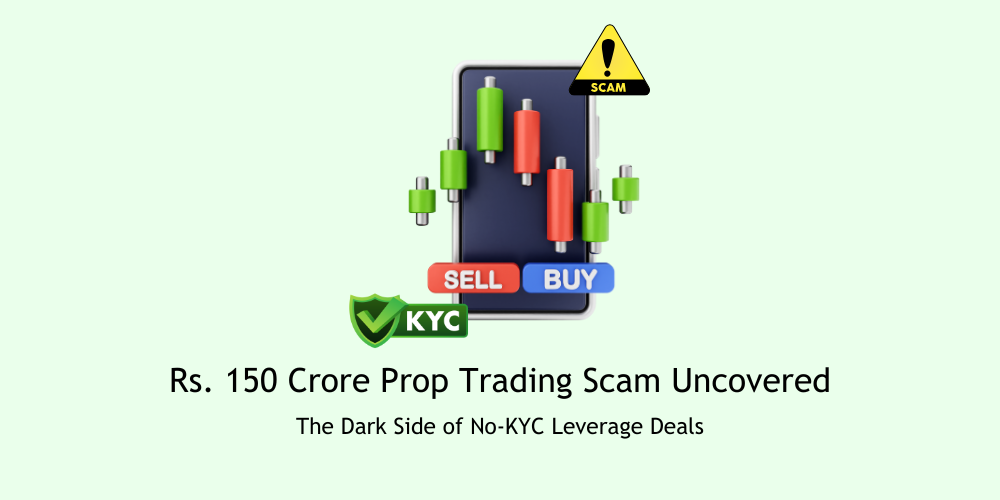
Rs. 150 Crore Prop Trading Scam Uncovered: The Dark Side of No-KYC Leverage Deals
Introduction
A major Rs. 150 crore proprietary trading scam has recently surfaced, revealing how certain brokers and intermediaries operated a parallel trading system completely outside regulatory supervision. Traders and investors from Mumbai, Delhi-NCR, and Rajasthan have reported that these entities were running off-the-record prop trading operations without conducting KYC, without documentation, and without maintaining any formal records. What initially appeared to be a simple arrangement that offered higher leverage soon exposed a darker reality—one where investor trust was openly exploited.
How the Prop Trading Loophole Was Turned Into a Scam
Proprietary trading, in its true form, allows brokerage firms to trade using their own capital. However, in this scam, the model was distorted to create an informal leverage-lending network that operated without transparency. Unregistered agents acted as the primary link between traders and brokers. These individuals arranged significant leverage, often far beyond legal limits, in exchange for deposits from traders. Funds were transferred through unrelated accounts, sometimes even in cash, ensuring that nothing was recorded formally. The arrangement ran smoothly as long as trades remained profitable, but a single loss or default often caused the entire system to collapse.
Why This System Thrived Behind the Scenes
The structure grew rapidly because it appeared beneficial to everyone involved. Traders were drawn in with the promise of unusually high leverage, sometimes up to seven times their deposited margin. Brokers benefited through brokerage charges and the interest they earned on margin funds parked with clearing houses. Meanwhile, agents made their share by increasing the interest charged on leveraged funds. This three-way arrangement created an illusion of a mutually profitable setup. Yet, beneath this illusion lay an unregulated, undocumented system with no accountability, making it extremely vulnerable when trades turned unfavourable.
The Real Dangers Hidden Behind High Leverage
The risk embedded in these informal prop trading arrangements became evident whenever a trader incurred heavy losses. Since leverage limits were stretched far beyond regulatory norms, even a small loss could wipe out the trader’s capital while leaving brokers exposed to large deficits. In many cases, brokers had availed bank guarantees or credit support to extend these limits, and defaults triggered a chain reaction that affected not just trading desks but also connected financial institutions. With no agreements or legal paperwork in place, affected investors often found themselves with no formal route to recover their funds, making the aftermath financially and emotionally exhausting.
How Investors Were Drawn Into the Trap
Many victims were introduced to these setups through online groups, social media channels, and closed trading communities. They were often shown fabricated profit screenshots, claims of insider-like strategies, and promises of exceptional returns with minimal capital. The idea of high leverage without documentation made the offer sound attractive, especially to traders seeking faster gains. What they did not realise was that the absence of KYC and written agreements stripped them of all legal protection. By the time the system collapsed, most investors discovered they had no formal standing to claim their money back.
What Sebi Rules Say and How They Were Ignored
Sebi’s regulations clearly state that proprietary trading accounts are meant exclusively for brokers trading with their own funds. These accounts cannot be used to pool money from the public or extend leverage to retail traders. However, in several regions including Mumbai, Gujarat, Rajasthan, Delhi-NCR, and Bengaluru, the misuse of prop accounts has become increasingly common. The situation worsened after derivative contract sizes increased, pushing unregistered entities to offer illegal leverage under the guise of proprietary trading. This unchecked expansion created a grey market that eventually led to widespread misuse.
A Crucial Warning for Investors and a Call for Stronger Oversight
The unmasking of this Rs. 150 crore scam serves as a serious reminder of the risks hidden within unregulated trading networks. For investors, the message is clear: any trading arrangement that bypasses KYC, avoids documentation, and promises unusually high leverage is a red flag. Offers that appear extremely lucrative often come with hidden dangers that can wipe out capital entirely. For regulators, the challenge lies in closing the loopholes that allow such informal networks to operate alongside legitimate brokerage systems. Strengthening oversight and enforcing stricter compliance norms will be essential to prevent similar scams from emerging in the future.
Frequently Asked Questions
-
What is prop trading?
Prop trading is when brokers trade using their own capital to make profits for the firm, not for clients.
-
Why is this prop trading scam dangerous?
Because trades were done without KYC or records, making it impossible for investors to recover money if things go wrong.
-
How were investors trapped?
They were lured with high leverage, low margin promises, and informal arrangements made by unregistered agents.
-
Is high leverage legal in India?
Only limited leverage is allowed. Extreme leverage outside exchange rules is illegal and unsafe.
-
How can investors stay safe?
Always trade through SEBI-registered platforms like Enrich Money ORCA ensure KYC is completed, and avoid any offer that promises huge leverage without documentation.
Disclaimer: This blog is dedicated exclusively for educational purposes. Please note that the securities and investments mentioned here are provided for informative purposes only and should not be construed as recommendations. Kindly ensure thorough research prior to making any investment decisions. Participation in the securities market carries inherent risks, and it's important to carefully review all associated documents before committing to investments. Please be aware that the attainment of investment objectives is not guaranteed. It's important to note that the past performance of securities and instruments does not reliably predict future performance.