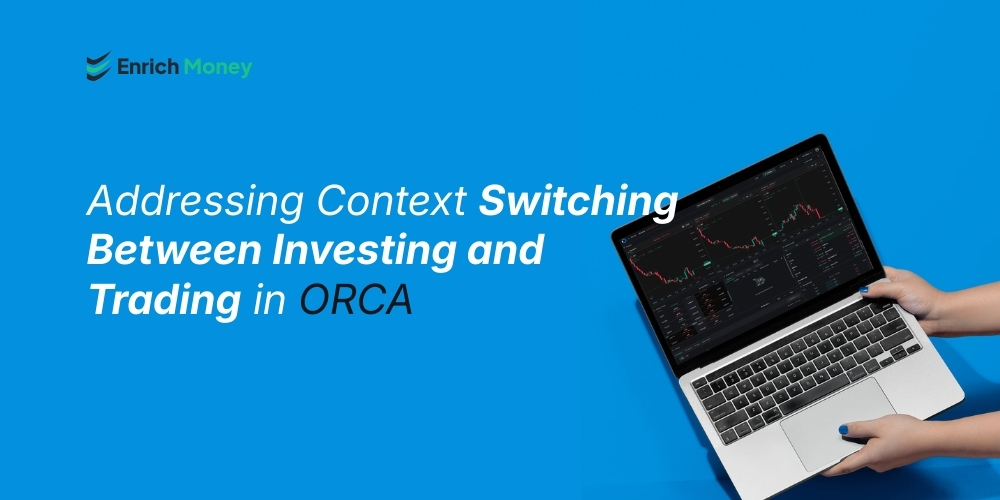
Addressing Context Switching Between Investing and Trading in ORCA
Introduction
Most market participants today operate across multiple time horizons. A user may track long-term investments while also reacting to short-term trading opportunities driven by news, volatility, or price momentum. However, many platforms separate investing and trading into different systems, forcing users to switch interfaces, log in multiple times, or reconfigure their workspace.
This constant context switching disrupts focus, increases cognitive load, and slows down decision-making especially during market hours. ORCA addresses this challenge by enabling users to manage both investing and active trading workflows within a single platform through a clearly defined Dual Mode structure.
The Challenge of Context Switching
Switching between investing and trading platforms introduces friction that often goes unnoticed until it affects outcomes. Common challenges include:
-
Interrupted analytical flow during fast-moving markets
-
Delays in execution during time-sensitive situations
-
Increased mental effort from managing multiple interfaces
-
Higher risk of errors due to fragmented workflows
For users who invest long-term and trade actively, these inefficiencies compound over time. ORCA reduces this friction by allowing users to change their operating intent without leaving the platform.
ORCA’s Dual Mode Workflow
ORCA offers two distinct operating environments within the same logged-in session:
-
Investor Mode – Designed for long-term portfolio monitoring and investment-focused analysis
-
Trade Mode – Built for active execution, real-time charts, and trading tools
Instead of separating these workflows across different platforms, ORCA allows users to switch between modes instantly. The interface adapts based on intent while preserving session continuity, data visibility, and account context.
Investor Mode: Focused on Long-Term Monitoring
Investor Mode is structured to support clarity and deliberate decision-making. It prioritises information relevant to long-term investing rather than rapid execution.
In Investor Mode, users can:
-
Monitor portfolio holdings and allocations
-
Track performance over longer time horizons
-
Review investment-related market information
-
Observe portfolio health without trading-related distractions
This environment is optimised for monitoring, analysis, and review helping users stay focused on long-term objectives.
Trade Mode: Built for Active Market Execution
When market conditions demand action, users can switch to Trade Mode with a single interaction.
Trade Mode provides a trading-focused workspace that supports:
-
Live charts and technical indicators
-
Option chains and derivatives data
-
Order placement and execution
-
Real-time position and risk monitoring
The transition from Investor Mode to Trade Mode does not require logging out or resetting the session. Users move directly from analysis to execution without losing momentum.
Switching Between Modes in ORCA
Once logged into ORCA, users can select their operating mode directly from the main interface. Switching modes instantly reshapes the workspace based on intent.
This design allows users to:
-
Move between monitoring and execution without delay
-
Retain full visibility of portfolio and account data
-
Avoid opening external tools or reconfiguring layouts

A Stock Moves Suddenly After News and You Need to Act Fast
A long-term investor monitors portfolio performance in Investor Mode during market hours. While reviewing holdings, one stock begins to move sharply following a breaking news event.
Instead of switching platforms, the investor transitions to Trade Mode within ORCA. The interface updates to display intraday charts and real-time price data, enabling immediate analysis of short-term price behaviour.
If required, the investor can place a short-term trade or hedge directly from the same platform. This workflow allows for a quick response to market developments without breaking context or managing multiple systems.
Mid-Trade, You Need to Check Your Long-Term Exposure
An active trader primarily operates in Trade Mode, focusing on execution and intraday price movements. While managing open positions, the trader wants to review long-term exposure or reassess investment allocations.
By switching to Investor Mode, the trader can review portfolio holdings without closing active trade screens. After completing the review, the trader switches back to Trade Mode and continues monitoring positions seamlessly.
This reduces the need for parallel logins or external portfolio tools during market hours.
Benefits of ORCA’s Dual Mode Structure
-
Reduces cognitive load caused by fragmented investing and trading workflows
-
Maintains continuity within a single logged-in session
-
Allows the interface to adapt based on intent monitoring or execution
-
Supports users who combine long-term investing with active trading
-
Minimises operational delays during volatile market conditions
Conclusion
Managing investing and trading activities requires flexibility without disruption. ORCA’s Dual Mode structure separates workflows by intent rather than by platform, reducing the friction associated with context switching.
By enabling instant transitions between Investor Mode and Trade Mode within a single environment, ORCA allows users to move smoothly between long-term observation and active execution. This design supports clearer decision-making and a more efficient experience for users who engage with markets across different time horizons.
Frequently Asked Questions
What is Investor Mode in ORCA?
Investor Mode is designed for long-term portfolio monitoring, investment analysis, and relevant market insights.
What is Trade Mode used for?
Trade Mode provides a trading-focused interface with charts, order placement, option chains, and active position monitoring.
Can users switch between Investor Mode and Trade Mode during market hours?
Yes, users can switch instantly at any time without logging out.
Is any data lost when switching modes?
No. Switching modes does not reset the session or require account reconfiguration.
Who benefits most from ORCA’s Dual Mode structure?
Users who combine long-term investing with active or intraday trading benefit most from reduced workflow disruption.
Disclaimer: This blog is dedicated exclusively for educational purposes. Please note that the securities and investments mentioned here are provided for informative purposes only and should not be construed as recommendations. Kindly ensure thorough research prior to making any investment decisions. Participation in the securities market carries inherent risks, and it's important to carefully review all associated documents before committing to investments. Please be aware that the attainment of investment objectives is not guaranteed. It's important to note that the past performance of securities and instruments does not reliably predict future performance.