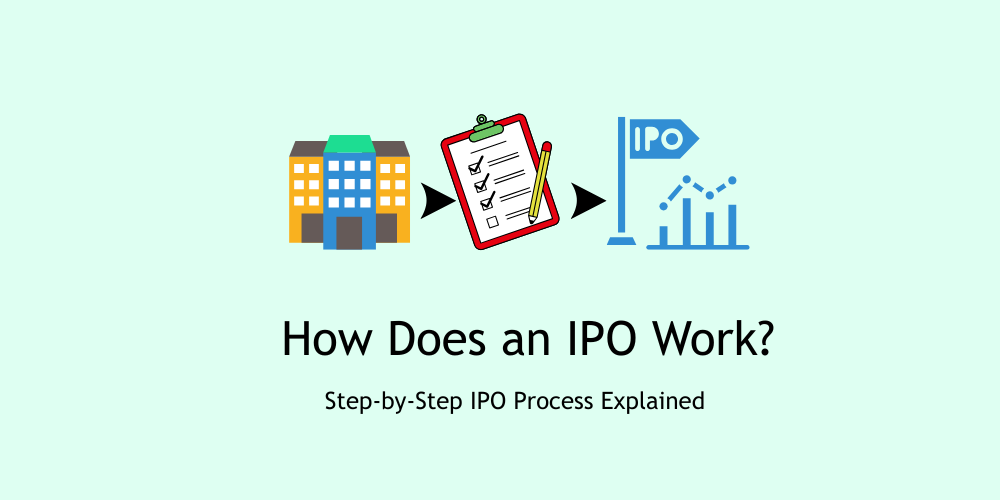
How Does an IPO Work? Step-by-Step IPO Process Explained
Introduction
If you’re new to markets, the term IPO (Initial Public Offering) can feel confusing. Don’t worry—I’ll walk you through the entire IPO journey in simple language so you can confidently decide when and how to apply. Think of an IPO as a company’s first public “share sale,” where it raises money from investors and gets listed on NSE/BSE so its shares can trade every day.
Below is a clear, step-by-step guide to the IPO process in India, the important terms, and the key dates you must track as an investor.
Step 1 — Company Decides to Go Public & Hires a Merchant Banker
-
The company (the “issuer”) chooses one or more merchant bankers / book-running lead managers (BRLMs) to handle the IPO.
-
These bankers help with due diligence, valuation, drafting documents, and coordinating with regulators and exchanges.
-
At this stage, the issuer also appoints other intermediaries such as registrars, legal advisors, auditors, and syndicate members.
Investor takeaway: Early media buzz starts here, but there’s no action for you yet. Stay alert for credible updates.
Step 2 — Draft Red Herring Prospectus (DRHP) Is Prepared & Filed with SEBI
-
The DRHP is a detailed disclosure document that explains the business model, financials, risks, promoters, use of proceeds, and more.
-
It is filed with SEBI (the securities regulator) and hosted publicly for investors to read.
-
After SEBI’s observations and the issuer’s clarifications, the final Red Herring Prospectus (RHP) is filed, which includes the price band, issue size, and timelines.
Investor takeaway: If you plan to apply, skim the business risks, debt levels, promoter background, and use of funds sections in DRHP/RHP.
Step 3 — SEBI Review & Observations
-
SEBI reviews the DRHP and may ask for clarifications or revisions.
-
Once satisfied, SEBI issues its observations, effectively green-lighting the issue to proceed (subject to conditions).
Investor takeaway: The timeline varies, but this is the longest regulatory phase. You don’t need to act—just note that SEBI observation ≠ investment advice; it only means disclosures meet requirements.
Step 4 — Roadshows, Marketing & Valuation Discovery
-
The bankers and management meet institutional investors (domestic & foreign) to gauge demand.
-
This helps fine-tune the valuation and the price band for book building.
-
Media coverage picks up; you’ll start seeing GMP (Grey Market Premium) chatter (more on this below).
Investor takeaway: Ignore hype. Focus on fundamentals and peer valuation.
Step 5 — Price Band & Issue Structure Announced
-
The price band (a range—for example Rs. 95–100) and lot size (minimum shares per retail application) are declared.
-
IPOs in India are typically book-built with quotas for:
-
QIBs (Qualified Institutional Buyers) — 50%
-
NIIs/HNIs (Non-Institutional Investors) — 15%
-
Retail investors — 35%
-
Some issues include an Offer for Sale (OFS) (existing shareholders selling) along with a Fresh Issue (new shares for fundraising).
Investor takeaway: Check lot size and maximum retail limit (usually up to Rs. 2 lakh per PAN for retail). Decide how many lots you can apply for.
Step 6 — IPO Opens for Subscription (T Day)
-
The issue remains open for 3 working days (typical).
-
Retail investors apply via ASBA (blocking funds in bank) or UPI through broker apps.
-
You can apply at cut-off price (automatically bids within the band to improve allotment chances) or choose a specific price within the band.
Investor takeaway:
-
If you’re unsure, cut-off is simplest for retail.
-
Apply well before the last day’s cut-off time to avoid UPI mandate delays.
Step 7 — Issue Closes; Subscription Data Finalises
-
At market close on Day 3, you’ll see final subscription figures (e.g., “Retail 10x, QIB 30x”).
-
Very high oversubscription means lower allotment probability in retail.
Investor takeaway: Oversubscription reflects demand but isn’t a guarantee of listing gains. Stay disciplined.
Step 8 — Basis of Allotment (BoA) Is Finalised
-
The registrar finalises allotments according to SEBI rules.
-
In retail, allotment is typically lottery-like when oversubscribed—designed to give fair chances across applicants.
IPO Allotment Process Explained
When an IPO receives applications from investors, the company has to decide who gets how many shares. This is called the IPO Allotment Process.
It is managed by the Registrar to the Issue ,not the broker or exchange.
Case 1: IPO is Not Oversubscribed
If the number of shares is greater than or equal to the total applications:
-
Every valid applicant receives the number of lots they applied for.
Case 2: IPO is Oversubscribed
If more people apply than shares available, then:
-
Retail allotment is done through a computerized lottery system.
-
Every valid applicant gets equal chance.
-
There is no first-come-first-serve and no manual selection.
Step-by-Step Allotment Process (Retail Category)
|
Step |
What Happens |
Meaning for Investor |
|
1. Total Retail Demand is Measured |
Registrar checks how many shares retail investors collectively requested. |
Shows whether IPO is oversubscribed. |
|
2. Check if Oversubscribed |
Compare total applied shares vs available shares in retail quota. |
Oversubscription → lottery allotment. |
|
3. Eligibility Check |
Invalid applications (wrong UPI, mandate not approved, multiple PANs, etc.) are removed. |
Only clean applications are considered. |
|
4. One Lot Distribution Rule Applied |
Every valid applicant gets equal chance to receive at least 1 lot. |
Number of lots you applied for does NOT increase chance. |
|
5. Computerized Lottery Runs |
Lottery assigns shareholders randomly and fairly. |
Some receive allotment, some don’t. |
|
6. Allotment Result Published |
Investor can check allotment status online using PAN / Application No. on registrar website. |
You know whether you received shares. |
|
7. Fund Unblocking / Share Credit |
If allotted → Shares credited to Demat; If not allotted → Funds are released. |
No money is lost if not allotted. |
Investor takeaway: You can check allotment status on the registrar’s website or on exchange links using your PAN/application number.
Step 9 — Refunds/Unblocking of Funds
-
If you’re not allotted, your ASBA/UPI funds are unblocked.
-
If partially allotted (in non-retail categories), the balance gets released.
Investor takeaway: Keep an eye on your bank/UPI app; the hold should clear soon after BoA.
Step 10 — Credit of Shares to Demat
-
Allotted shares appear in your Demat account (NSDL/CDSL) before listing day.
Investor takeaway: If shares don’t show up, contact your broker/DP and the registrar with your application details.
Step 11 — Listing Day: Trading Starts on NSE/BSE
-
On listing day, the stock opens at a discovered price based on market demand and starts trading.
-
You may see listing gains (price above issue price) or discounts (below issue price).
-
Liquidity, sector sentiment, and overall market mood drive early volatility.
Investor takeaway: Have a plan—book listing gains if that was your goal, or hold long-term if you believe in fundamentals. Avoid impulsive trades.
IPO Process Timelines (Indicative)
|
IPO Stage |
What Happens Here |
|
Planning & Appointment of Merchant Bankers |
Company selects investment banks, advisors, legal & compliance teams. |
|
Due Diligence & Financial/Legal Review |
Bankers & auditors verify books, risks, governance, business model disclosures. |
|
DRHP Drafting & Filing with SEBI |
Draft Red Herring Prospectus (DRHP) prepared and submitted for review. |
|
SEBI Review & Observations Phase |
SEBI evaluates disclosures and may request clarifications/changes. |
|
Final Prospectus (RHP) & Price Band Announcement |
Issuer submits RHP & confirms issue size, price band, and timeline. |
|
IPO Opens for Subscription |
Retail, NII/HNI, and QIB bidding takes place. Applications via UPI/ASBA. |
|
Basis of Allotment Finalised |
Registrar finalises allotment based on investor category & demand. |
|
Refunds / Unblocking of Funds |
Unsuccessful applicants get UPI/ASBA funds unblocked. |
|
Shares Credited to Demat Accounts |
Allotted shares appear in investor’s CDSL/NSDL demat account. |
|
Listing on NSE & BSE |
Stock begins trading; first traded price discovered based on market demand. |
|
Post-Issue Compliance & Reporting |
Legal, regulatory, and investor communications continue post-listing. |
Important IPO Terms
-
DRHP (Draft Red Herring Prospectus): Early disclosure document filed with SEBI; no final price.
-
RHP (Red Herring Prospectus): Updated prospectus with price band, issue size, and timelines.
-
IPO Date:The period (start and end dates) during which investors can apply for the IPO.
-
Listing Date:The date on which the company’s shares start trading on NSE & BSE.
-
Issue Size:The total amount the company aims to raise through the IPO (Fresh Issue + Offer for Sale).
-
Minimum Investment Amount:The cost of one lot (Lot Size × Price). This is the minimum amount required to apply in retail category.
-
Subscription:Subscription means how many investors applied compared to shares available
-
Allotment:Allotment means how the company decides who gets shares.
-
ASBA: Applications Supported by Blocked Amount—your money stays in the bank until allotment.
-
UPI ID: Payment method for retail IPO applications through broker/bank apps.
-
Book Building: Bidding process within a price band to discover the final offer price.
-
Price Band: Upper and lower price range (e.g., Rs. 95–100).
-
Cut-Off Price: For retail investors to maximise allotment chance without choosing a specific price.
-
Lot Size: Minimum number of shares you must apply for in one lot.
-
QIB / NII / Retail: Investor categories with reserved quotas.
-
OFS (Offer for Sale): Existing shareholders sell part of their stake—proceeds go to them.
-
Fresh Issue: Company issues new shares—funds go to the company.
-
GMP (Grey Market Premium): Informal market premium before listing—unofficial, not regulated; treat cautiously.
-
Basis of Allotment (BoA): Final distribution of shares among applicants as per SEBI rules.
-
Listing Gains: Price appreciation on listing day compared to issue price.
-
Anchor Investors: Qualified institutions allotted shares one day before the issue opens (in some IPOs).
Important IPO Dates Investors Must Track
|
Key Date |
Importance |
|
Issue Open Date |
Day IPO begins accepting applications |
|
Issue Close Date |
Last date to apply |
|
UPI Mandate Approval Deadline |
Must approve payment request in time; else application becomes invalid |
|
Allotment Finalisation Date |
Check if shares were allotted or not |
|
Refund / Fund Unblocking Date |
Blocked funds are released if you don't get allotment |
|
Share Credit to Demat Date |
Shares appear in your Demat before listing day |
|
Listing Date |
Stock starts trading on NSE & BSE |
|
UPI Mandate Expiry Date |
UPI block auto-expires if funds not used |
|
Anchor Investor Lock-in End Date (50%) |
First 50% unlocks 30 days after listing |
|
Remaining Anchor Lock-in End Date (50%) |
Remaining unlocks 90 days after listing |
How to Decide Whether to Apply (Simple Checklist)
Business & Financials
-
Understand revenue model, margins, growth, and cash flows
-
Compare valuation multiples (P/E, P/B, EV/EBITDA) with listed peers
-
Check debt, related-party transactions, and risks in DRHP/RHP
Use of Proceeds
-
Prefer issues where funds go to growth capex, R&D, debt reduction rather than only OFS
Management Quality
-
Promoter background, corporate governance, and track record
Market Context
-
Sector tailwinds, benchmark trends, and liquidity
For New Investors
If you want diversified exposure without analysing each offer, consider equity mutual funds or broad-market ETFs; for IPO-specific hype, be cautious—volatility can be high.
Pro Tips for Retail Investors
-
Apply at cut-off if you’re unsure of price.
-
Avoid last-minute UPI approvals—mandates can time out.
-
Don’t chase only GMP buzz; it’s unregulated.
-
Size your application—don’t exceed what you can comfortably block.
-
After listing, use stop-losses if you are trading for short-term gains.
-
Long-term investing? Re-read the risk factors and track quarterly results post-listing.
FAQs
Q1. Can I apply through multiple broker apps?
Apply once per PAN in the retail category. Multiple applications can be rejected.
Q2. What if I don’t get allotment?
Funds are unblocked and you pay nothing. You can consider buying post-listing if valuations make sense.
Q3. Is there a minimum amount to apply?
You must apply for at least one lot. Minimum amount = lot size × issue price. Example: lot size 150 shares × Rs. 100 = Rs. 15,000.
Q4. How soon do shares credit to Demat?
Usually before listing day—typically within a couple of working days after BoA.
Q5. Do I have to pay brokerage for IPO application?
Most brokers don’t charge brokerage for IPO applications; check your broker’s policy.
Conclusion
Now you know how an IPO works—from DRHP to listing day—and the key terms and dates that matter. Use this guide as your evergreen checklist before applying to any issue. If you’re a beginner, start small, avoid hype, and make decisions based on fundamentals, not noise.
Disclaimer: This blog is dedicated exclusively for educational purposes. Please note that the securities and investments mentioned here are provided for informative purposes only and should not be construed as recommendations. Kindly ensure thorough research prior to making any investment decisions. Participation in the securities market carries inherent risks, and it's important to carefully review all associated documents before committing to investments. Please be aware that the attainment of investment objectives is not guaranteed. It's important to note that the past performance of securities and instruments does not reliably predict future performance.